

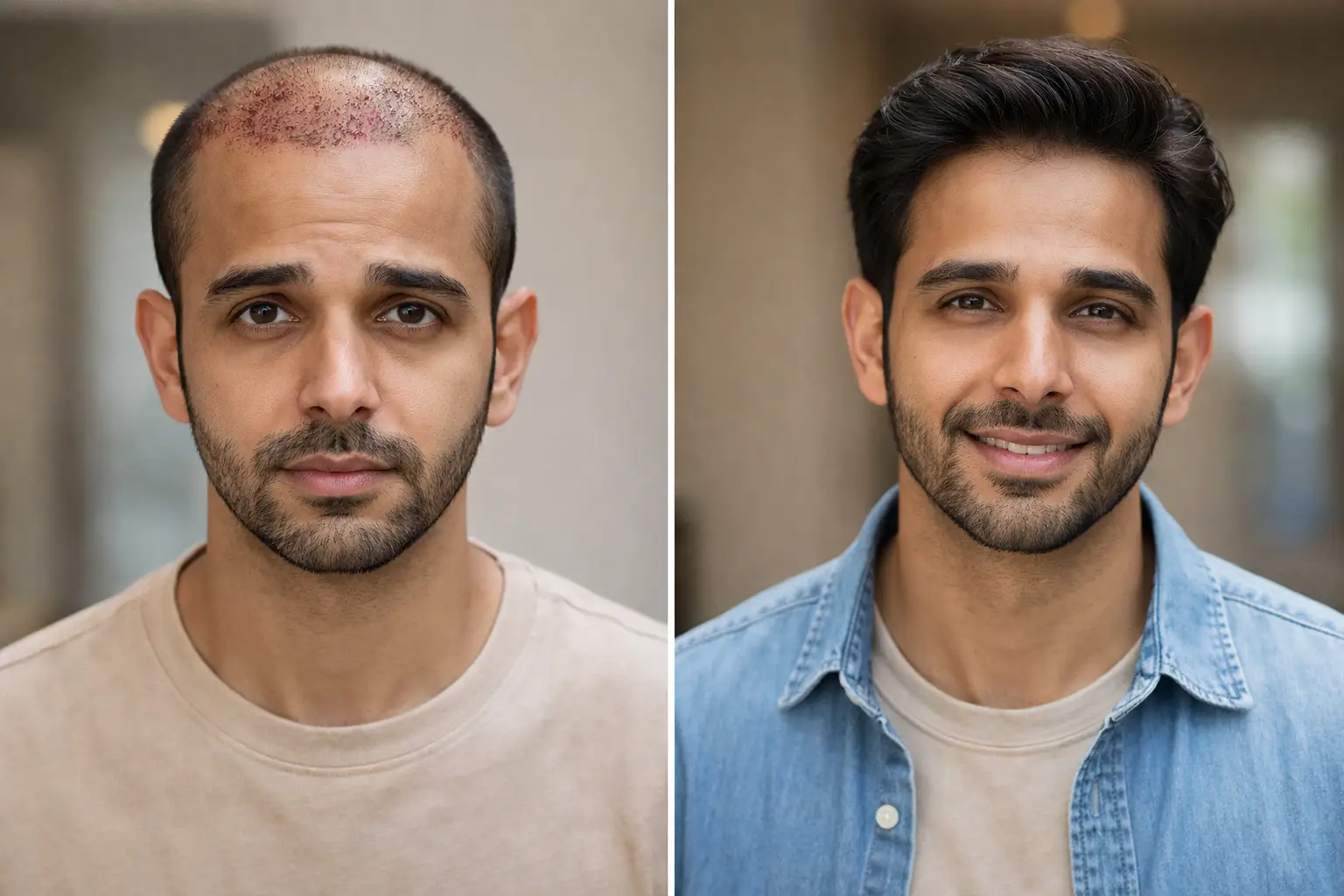
You’ve heard transplants are permanent. You’ve heard systems need maintenance. You want to know which one is actually right for you, not which one sounds better in a brochure.
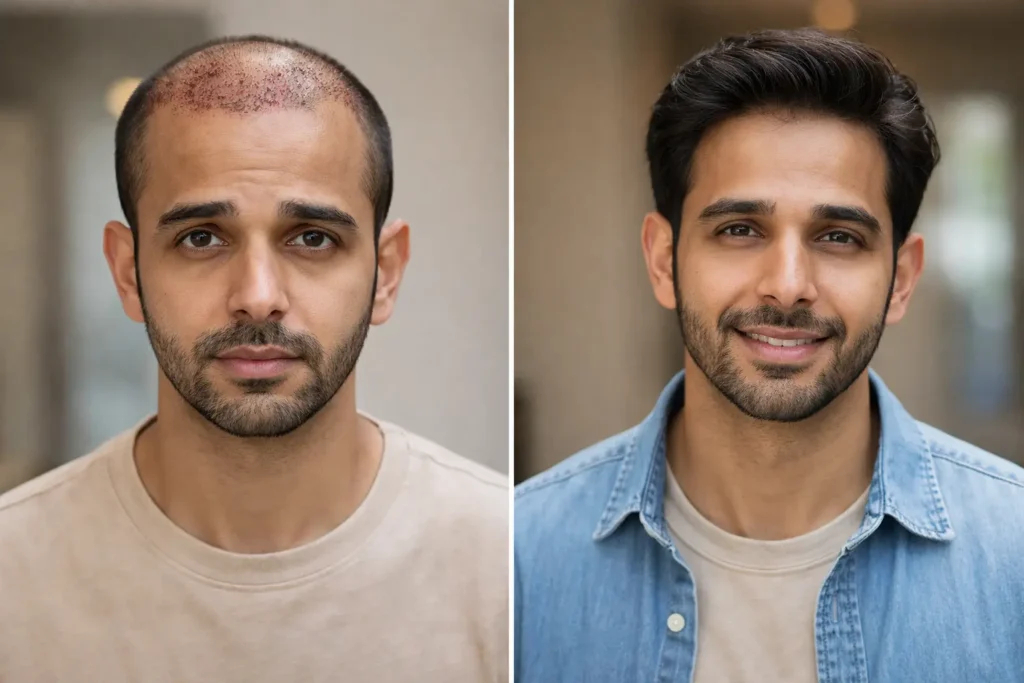
Most comparison guides are written by transplant clinics or hair system studios. Both have a reason to push you one way. This guide doesn’t. Both options are legitimate. They suit different people, different budgets, and different stages of hair loss.
Hair transplants carry real risks. Shock loss. Scarring. In rare cases, permanent loss of existing hair. Most clinic websites don’t mention this upfront. You deserve the full picture before you decide.
New to hair systems entirely? Read our complete beginner’s guide to non-surgical hair replacement first. If you already know the basics, let’s compare.
Table of Contents
The core difference in one sentence
A transplant moves your own hair follicles from the back of your scalp to bald areas. A hair system adds new hair on top of your scalp without touching your follicles.
One is surgery. One is not. Everything else flows from that difference.
Head-to-head: the honest comparison
| Factor | Hair system | Hair transplant |
|---|---|---|
| Time to results | Same day | 10–14 months |
| Surgery or pain | None | Local anaesthesia, recovery week |
| Cost India (total) | ₹25,000–₹60,000 / year | ₹60,000–₹2,00,000 upfront |
| Works at Norwood 5–7 | Yes — always | Limited by donor hair |
| Reversible | Yes — remove anytime | No |
| Ongoing maintenance | Every 4–6 weeks | Minimal after recovery |
| Permanence | Semi-permanent (rebonded regularly) | Permanent result |
| Suitable for everyone | Yes | No — candidacy restrictions apply |
The transplant wins on permanence and low ongoing maintenance. The hair system wins on everything else. Keep that in mind as you read on.
What transplants don’t tell you upfront
A good surgeon will tell you all this. Many don’t. Here is what to ask about before you book.
Shock loss
Most transplant patients experience shock loss. Surgical trauma causes nearby hair to fall out. Usually temporary. Not always. It usually grows back. But not always.
Indian patients face three common complications. Shock loss. Folliculitis. Poor density. In weakened follicles, the hair loss can be permanent.
Not everyone qualifies
Transplants are not suitable for everyone. You may be rejected if your hair loss is still progressing rapidly. If you are under 25. If your donor area is too thin. If your expectations don’t match what surgery can deliver at your stage.
Hair systems have none of these restrictions. Anyone can wear one. At any stage. Starting today.
You will look worse before you look better
Shock loss peaks around weeks two to six post-surgery. For those weeks, you will have less hair than you started with. Then slow stub growth begins. Final results arrive at month 10 to 14. That is a long time to wait, and a hard few months to live through.
The real cost over 5 years (INR)
Most people assume transplants are cheaper long-term. The numbers tell a different story.
| Cost item | Hair system | Hair transplant |
|---|---|---|
| Year 1 (system + fitting / surgery) | ₹15,000–₹25,000 | ₹60,000–₹2,00,000 |
| Annual maintenance (years 2–5) | ₹18,000–₹40,000 / year | ₹0–₹5,000 / year |
| 5-year total | ₹33,000–₹1,85,000 | ₹60,000–₹2,20,000 |
Over five years, the costs are surprisingly close. A mid-range hair system often costs less than a mid-range transplant. Most clinicians won’t operate until 50% of hair is already gone. That means many men in early stages don’t qualify yet anyway.
Which option suits your stage of hair loss?
| Norwood stage | Hair system | Hair transplant | Recommendation |
|---|---|---|---|
| Stage I–II | Works well | Works well | Either — if loss is stable |
| Stage III–IV | Excellent | Good | System for speed, transplant if patient |
| Stage V–VII | Excellent | Limited donor hair | Hair system strongly preferred |
| Under 25 | Excellent | Risky — loss still progressing | Hair system recommended |
| Women | Excellent | Limited candidacy | Hair system or topper |
Young men under 25 deserve a specific note. Hair loss at that age is almost always still progressing. A transplant now could look uneven in five years as surrounding hair continues to fall. A system gives you results today without locking in a surgical decision you may regret.
The 10–14 month wait: what nobody talks about
The transplant timeline isn’t just a medical detail. It is a lived experience. Here is what those months actually look like:
Surgery day
Procedure takes 6–8 hours. Scalp is red, swollen, dotted with small crusts where grafts were placed.
Weeks 2–6
Shock loss begins. You shed existing hair around the transplant zone. For most people, this is the lowest point. You look worse than before surgery.
Months 3–6
Transplanted hairs begin growing as thin stubs. Coverage is patchy. Results are not yet visible to anyone else.
Month 10–14
Final results visible. For many patients, this is genuinely transformative. For others, especially at advanced stages, density disappoints.
Now contrast that with a hair system. You sit in a chair for two to four hours. You leave looking transformed. Same day.
The confidence question
Both options exist for the same reason. To give you your confidence back.
This isn’t vanity. JAMA Dermatology shows hair loss genuinely reduces quality of life. Fixing it genuinely improves it. That’s not vanity. That’s your wellbeing.
A hair system delivers that outcome on day one. A transplant delivers it in month 12. Both are valid. The question is how long you are willing to wait — and what your life requires right now.
Not sure if it’s right for you?
The honest answer is: it depends on your stage of hair loss, your timeline, and your budget. Free 30-minute consultation. Honest answer. Even if that answer isn’t us.
Frequently asked questions
Can I get a hair transplant later if I start with a system?
Yes. Many people do exactly this. A system gives you results today. It doesn’t affect your scalp, your follicles, or your candidacy for a transplant later. You can switch at any point.hair system?
Is a hair system less “real” than a transplant?
No. Both restore appearance. One uses your own biology; the other uses human hair bonded to your scalp. The person looking back at you in the mirror doesn’t know the difference. The result is what matters.
Do hair systems damage the scalp or affect future transplants?
No. A properly applied and maintained system doesn’t touch your follicles. Scalp health is preserved with a regular cleaning and rebonding routine. Future transplant candidacy is unaffected.
Is a hair transplant painful?
The procedure uses local anaesthesia — you won’t feel the surgery itself. Recovery involves swelling, itching, and 7–14 days of visible signs. Most people take a week off work.
Which is better for men under 25?
A hair system. Hair loss at that age is almost always still progressing. A transplant now could look uneven in five years as surrounding hair continues to fall. A system gives results today without a permanent surgical decision.
Our verdict: which should you choose?
If you want permanent results and can wait 12 months: a transplant at a qualified clinic may be right for you. Make sure your hair loss is stable first. Make sure you qualify. Ask about shock loss.
If you want results today, no surgery, lower upfront cost, and the freedom to change course: a hair system wins. For most men reading this — especially at Norwood III and above — it is the stronger choice.
The two options are not opposites. Many of our clients wear a system now and consider a transplant later. You don’t have to choose forever. You just have to choose what works right now.
Come in, ask every question, leave knowing exactly where you stand. No obligation to book.