

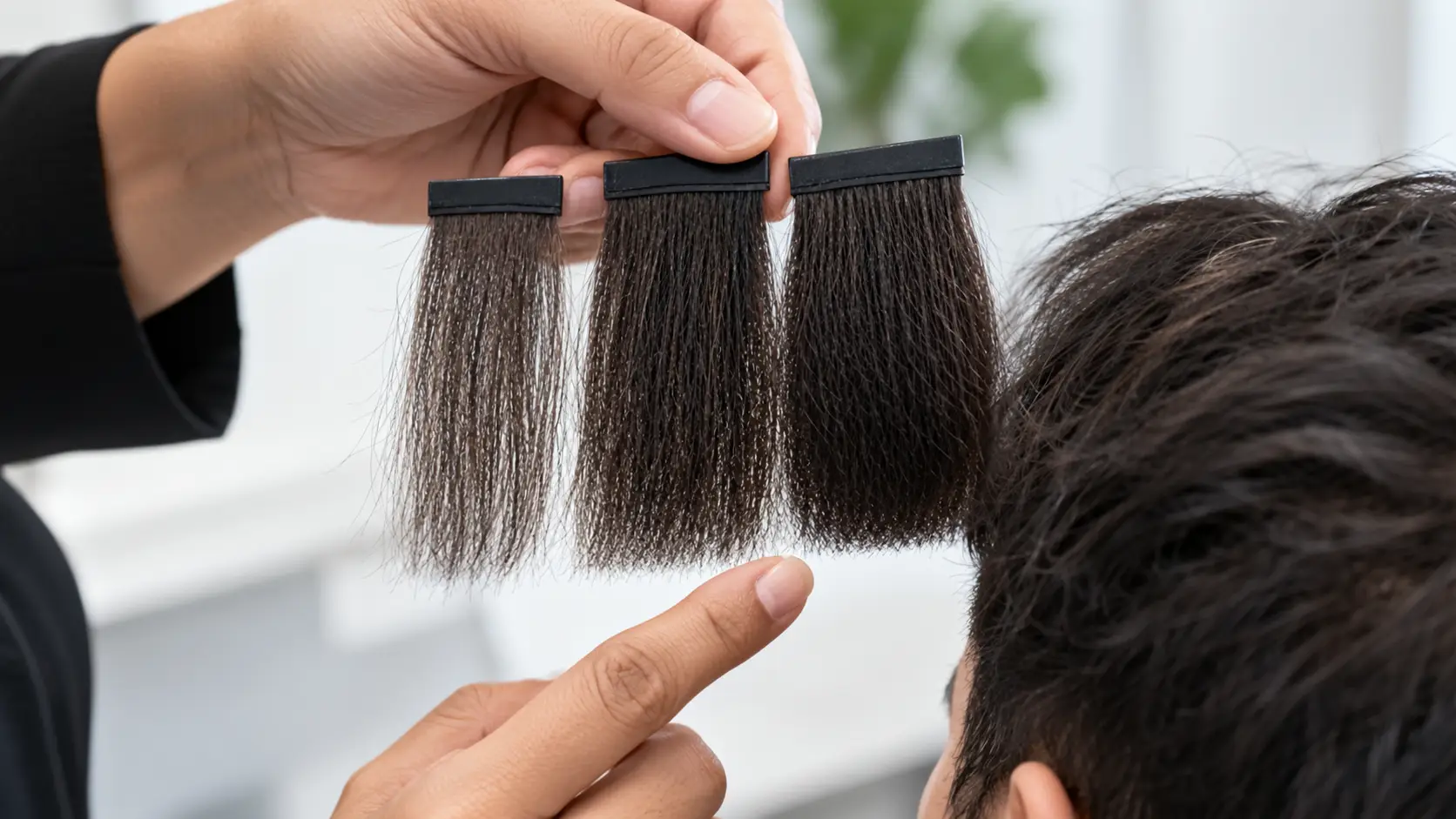
Hair density is how many hair strands sit on every square centimeter of your hair system’s base. Choose it too high and the system looks fake. Choose it too low and it looks thin. The right number depends on your own natural hair, your age, and in Mumbai’s climate, your comfort too.

Here’s how to actually get it right.
Table of Contents
What Hair Density Means
Manufacturers measure density as a percentage. Most stock systems have 100% density, also called medium-light density. This works well for most men without looking too thick or too thin.
Higher percentages, like 120% or 130%, add more hair strands per square centimeter. Lower percentages, like 70% or 80%, add fewer. Neither number is right or wrong on its own. It depends entirely on what your own hair looks like.
Match It to Your Own Hair, Not a Photo
The most important rule is simple: match the system density to your natural hair. Do not choose it based on a photo you like online.
If your natural hair is fine or thin, a dense hair system creates an obvious contrast right at the blend zone. The system looks like it’s sitting on top of your head instead of growing out of it. If your natural hair is thick and full, a lower density system can look sparse by comparison.
This is the mistake almost every guide warns about, and it’s still the most common one people make. More hair isn’t the goal. A believable match is.
Age Changes the Right Answer
Hair naturally thins as you get older. A density that looks natural on someone in their twenties may look too full on someone in their fifties.
Younger men can often handle a slightly heavier density without it looking unnatural. Older men often look more natural with lighter hair density. It should match how their natural hair looks at that age.
Density Affects Which Base You Can Use
Not every base material supports every density level. Lighter densities need a finer, more delicate base, like full lace. Heavier densities need a stronger base to hold that much hair securely.
This means density and base choice aren’t separate decisions. They affect each other. Choosing one without considering the other can make the hair look mismatched.
Why Density Matters More in Mumbai Than Most Places
Here’s the part most density guides skip entirely.
More hair strands mean more hair mass sitting against your scalp. That mass holds onto heat and moisture longer, both while you’re wearing the system and after you clean it. A denser system takes longer to fully dry.
Materials that trap moisture can hold sweat against the skin. This can cause skin irritation, according to PubMed research.
A denser base can stay damp for longer after cleaning. This can be a bigger problem in Mumbai’s heat and humidity.
This matters even more because fungal skin infections are common in hot and humid areas. Rates can reach 40% in some tropical regions, according to a PMC review. A lighter density, or a stricter drying routine if you prefer a fuller look, both reduce that risk.
This doesn’t mean heavier density is unsafe. It needs more care and cleaning in Mumbai’s heat and humidity. It may need less care in a cool, dry place.
Transitional Density: The Middle Ground
You don’t have to pick one flat density across the whole system. Many hair systems use different density levels. The hair is lighter at the front and gets fuller toward the crown.
This mimics how real hair actually grows. Natural hairlines are softer and less dense right at the edge. A transitional approach gives you a believable hairline without sacrificing fullness everywhere else.
A Simple Starting Point
If you’re choosing for the first time, medium-light density, around 100%, is a good starting point. It sits in the middle of the range and works for most men without needing heavy customization.
From there, you can adjust up or down once you’ve worn it and have a clearer sense of what looks and feels right.
How Density Actually Gets Decided
This isn’t a number you should guess alone from a blog post or a photo. During your consultation, we check your natural hair density, age, and lifestyle. This helps us choose the right density for your hair. It is part of how density gets decided during your fitting, not guessed from a photo.
Density also changes how you’ll need to care for the system day to day. Our guide explains why a denser system needs more thorough drying. This is especially important during Mumbai’s hot and humid months.
Many first-time clients think more density means a better result. But a more natural look usually comes from matching their own hair, not adding more hair
Frequently Asked Questions
What is hair density in a hair system?
It’s the number of hair strands attached per square centimeter of the base, shown as a percentage. Higher percentages look fuller. Lower percentages look lighter and more natural on thinner hair types.
What hair density should a beginner choose?
Medium-light density, around 100%, is a safe starting point for most men. It’s full enough to look natural without looking obviously dense.
Does hair density affect comfort in hot weather?
Yes. More hair can hold heat and moisture against the scalp for longer. It also takes longer to dry after cleaning. A lighter density can improve comfort in Mumbai’s heat and humidity.
Can hair density be changed after the system is made?
To a limited degree. You can reduce the density slightly with the right tools. But this is not recommended. It can leave short hairs against the base, making it feel rough and look less natural.
Does density affect which base I can use?
Yes. Lighter densities pair with finer, more delicate bases like lace. Heavier densities need a stronger base material to hold that much hair securely.
What’s the most common mistake when choosing hair density?
Choosing a density that’s higher than your own natural hair at the sides and back. It creates a visible contrast at the blend zone instead of a seamless match.
Not sure what density actually matches your own hair? Book a consultation and we’ll match it to your natural hair and lifestyle, not a photo you found online.
Written with input from Radice Rinnova’s hair system specialists and their work with clients in Mumbai.
