

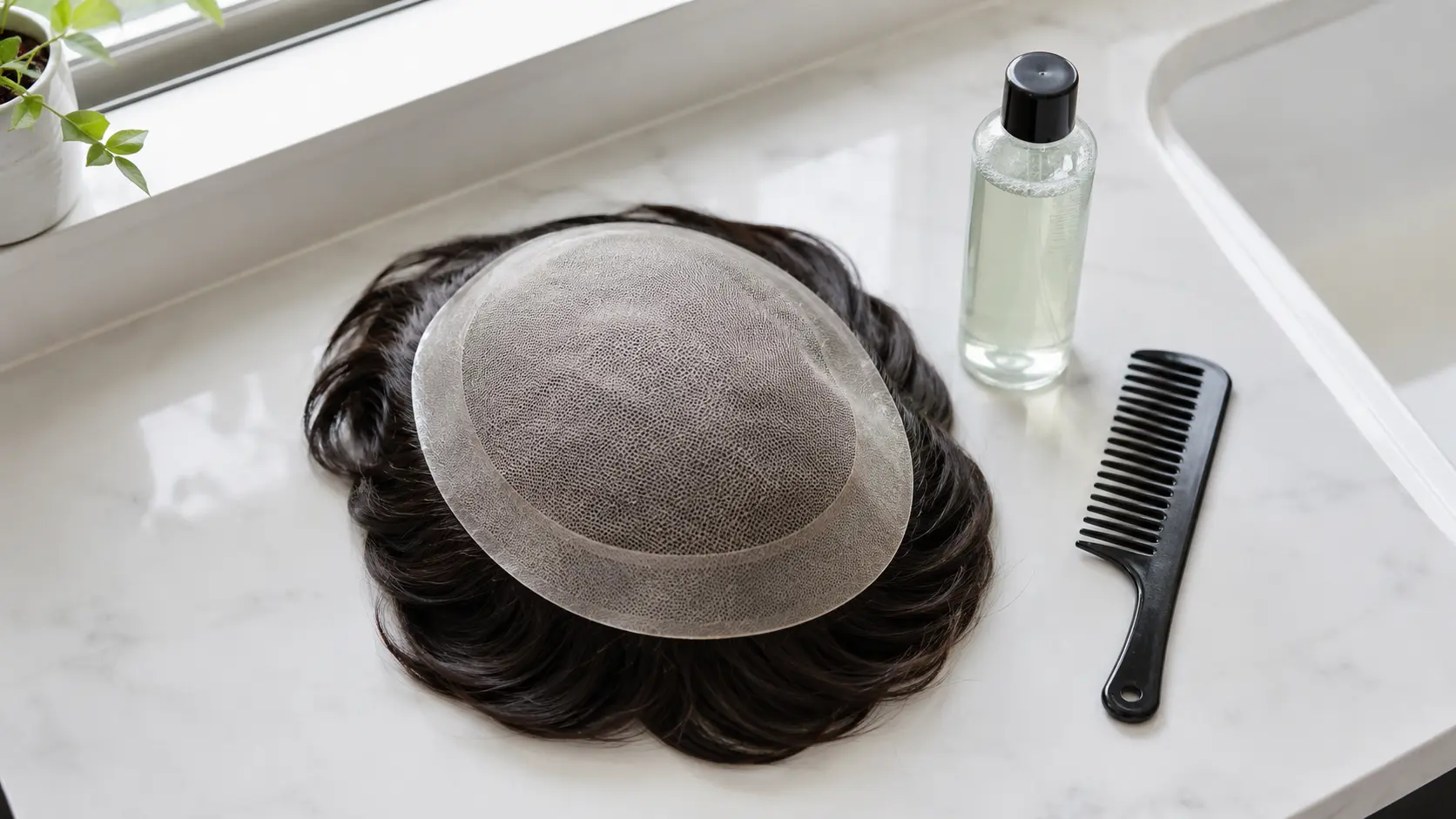
Cleaning your hair system at home is easy. First, remove any adhesive residue. Then wash the hair and base with a sulfate-free shampoo. Apply conditioner from the middle of the hair to the ends. Let it air-dry on a wig stand. Repeat this process every 7–14 days, depending on your climate and how often you wear it.
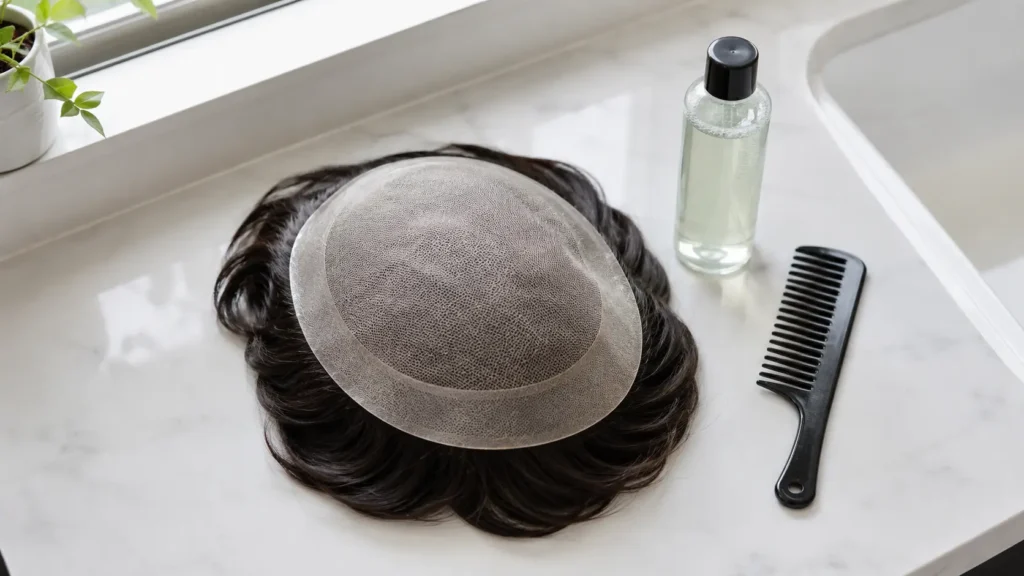
A clean system looks natural, bonds better, and lasts significantly longer. If you do not clean it regularly, sweat, oil, and adhesive can build up. This can reduce the lifespan of even a high-quality hair system.
Scalp hygiene under a hair system matters. The International Society of Hair Restoration Surgery (ISHRS) recommends regular scalp care. Trapped oils and residue can irritate the skin. They can also weaken the adhesive over time.
This guide explains each step of the cleaning process. You will learn how to remove adhesive, wash your hair system, and dry it properly. You can do it all at home with confidence.
Table of Contents
What You’ll Need Before You Start
Keep these items ready before you begin. You likely have most of them at home already.
- Adhesive remover, citrus-based formulas work well for both tape and glue residue
- Sulfate-free, paraben-free shampoo, regular shampoo strips moisture and fades colour faster
- Wide-tooth comb or soft vent brush
- Clean microfibre towel
- Small container, for soaking the base
- Wig stand or mannequin head, for drying in shape
Avoid household cleaners, acetone, or alcohol-based products directly on the base. These degrade the material and weaken the knots.
Step 1: Remove Adhesive and Tape First
Never shampoo over old adhesive. It traps residue deeper into the base and makes the next bond weaker.
Start by peeling any tape from the edges of the base. Use your fingernail to lift the corner gently, never pull from the hair strands. Work slowly around the perimeter.
Next, apply adhesive remover directly onto the base. Allow it to sit for 2–3 minutes. This softens the glue without you needing to scrub.
For skin base systems: use an old plastic card. A gift card works well. Gently scrape away the softened residue using short vertical strokes. Work outward from the centre.
For lace base systems: Skip the card. Use a soft nail brush instead and brush the residue outward in light strokes. Pressing hard on lace tears the mesh. To learn more about how your base type affects cleanin.
Once most residue is off, wipe the base clean with a dry cloth before moving to the next step.
Step 2: Soak and Loosen Remaining Residue
Pour adhesive remover into a small container. Place the hair system base-down in the solution and let it soak for 3–5 minutes.
Remove it from the container and turn it inside-out in the sink, hair facing down. This gives you full access to the base surface.
While the base is still wet with remover, apply a small amount of dish soap directly onto it. The soap neutralises any remaining tack. Use your fingertips to work it across the base in light circular motions.
Rinse with lukewarm water. Never use hot water, heat weakens the base material and causes lace to lose its shape over time.
Step 3: Shampoo the Hair and Base
Pour a small amount of sulfate-free shampoo onto your palm. Work it gently through the hair from root to tip, always in one direction.
Do not scrub, bunch, or rub the hair against itself. This causes tangling, matting, and accelerated strand loss.
Rinse thoroughly with cool or lukewarm water. Let the water run downward through the base, the same direction the hair falls. Repeat the shampoo step if the system has heavy buildup or if it has been more than two weeks since the last clean.
Step 4: Condition, Don’t Skip This
Hair systems have no sebum production. The hair cannot replenish its own moisture the way natural hair does. Conditioning is what keeps the strands soft and prevents early drying and breakage.
Apply conditioner from mid-shaft to the tips only. Do not apply it to the base or near the knots, conditioner on the knots loosens them over time.
Leave it on for 2 minutes. Then rinse fully with cool water.
Hair systems can become dry between washes. This is common in air-conditioned offices and during winter. A light leave-in conditioner spray can help. Apply it to the hair lengths to keep the system looking natural.
Step 5: Dry It Right
How you dry your hair system matters as much as how you wash it.
Gently squeeze excess water from the hair using your hands. Then lay the system on a clean microfibre towel and pat, do not rub. Rubbing with a towel causes frizz, tangling, and fibre damage.
Place the system on a wig stand or mannequin head immediately. This preserves the shape of the base while it dries.
Air-dry only. Do not use a blow dryer directly on the base. Heat can damage the adhesive areas. It may also warp the base material. If you need to speed up drying, use a blow dryer on the lowest cool-air setting, held at least 30 cm from the base.
Do not brush until the system is completely dry. Wet hair, whether natural or in a system, is at its most vulnerable. Brushing wet strands causes breakage and pulls fibres from the base.
Store away from direct sunlight when not in use.
How Often Should You Clean Your Hair System?
If you wear the same hair system for 4–6 weeks, clean it at least every 1–2 weeks while wearing it. Remove, clean fully, and reattach.
For daily-wear users, a light wash 1–2 times per week is enough. Do not wash your hair system more than twice a week. Too much washing can remove moisture and shorten the life of the hair.
Why Mumbai’s Climate Means You Need to Clean More Often
This is the section most guides miss, and it matters if you wear a hair system in India.
Mumbai’s heat and humidity can make hair system maintenance more difficult. They speed up many of the issues that wearers need to manage. Sweat and sebum build up under the base within days, not weeks. Adhesive breaks down faster in humidity. During the monsoon, heat and moisture can weaken your hair system bond faster. A bond that lasts three weeks in a cooler climate may last only ten days.
Pollution is the other factor. Fine particulate matter, dust, vehicle emissions, construction debris, settles into lace bases specifically. Lace hair systems in Mumbai may show dirt and buildup more quickly. As a result, the edges of the base can darken faster than in areas with cleaner air.
Practical cleaning schedule for Mumbai wearers:
- Summer (March–June): Clean every 7 days
- Monsoon (July–September): Clean every 7 days, check adhesive edges every 4–5 days
- Winter (October–February): Clean every 10–14 days
At Radice Rinnova, we often recommend a 7-day cleaning schedule during the monsoon. It helps maintain adhesive performance longer than a 14-day cleaning cycle. The difference in system lifespan is visible.
Need a professional cleaning, rebonding, or maintenance advice? The team at Radice Rinnova in Andheri West can refresh your hair system in a single session.
Conclusion
Cleaning your hair system at home is simple. Remove the adhesive first. Then soak the system to loosen residue. Wash it with shampoo, apply conditioner, and let it air-dry on a wig stand. Do it every 7–14 days, adjusting to 7 days if you live in Mumbai, especially through summer and monsoon. Regular cleaning helps your hair system last longer. It also keeps the hair looking natural every day.
FAQ
How often should I clean my hair system?
Clean your hair system every 7–14 days if you wear it continuously. Mumbai’s hot and humid weather can affect your hair system. Clean it every 7 days during summer and the monsoon. This helps prevent adhesive breakdown and scalp buildup. Daily-wear users can wash gently 1–2 times per week.
Can I use regular shampoo on my hair system?
No. Many regular shampoos contain sulphates and parabens. These ingredients can dry out the hair, fade the colour, and damage the base over time. Use a sulfate-free, paraben-free shampoo specifically suitable for human hair systems.
How do I remove adhesive from my hair system at home?
Apply a citrus-based adhesive remover to the base and let it sit for 2–3 minutes. For skin bases, scrape gently with a plastic card. For lace bases, use a soft nail brush and light outward strokes. Never use acetone or household solvents, they damage the base permanently.
Will cleaning my hair system too often damage it?
Over-washing, more than twice a week, can dry out the hair and loosen the knots at the base. Stick to the recommended frequency for your wear schedule and climate. Conditioning after every wash protects the hair from dryness caused by repeated cleaning.